
Reviewed · ESCAPE GAMES & SCAVENGER HUNTS
Solve the Case: Self-Guided Mystery Puzzle Walk in Philadelphia
Solve Philly by following clues.
I like that it turns a classic history route into an app-guided mystery where you don’t just read plaques. I also like the offline directions, so you can keep moving even with spotty cell service. One drawback to plan for: it depends on your phone battery and actually using the app, so if you’re not a fan of screens or you forget to charge, the experience can feel harder than it needs to be.
This is a self-paced game run by the Questo app, so you can start at your own hour, pause, and resume later. You’ll work through a chain of checkpoints around Philadelphia, solving a challenge to move to the next location while picking up real-world context about places like the Liberty Bell and Reading Terminal Market.
If you’re traveling solo, with friends, or as a family (it’s free for kids), this format is a fun way to see a lot without waiting for a group schedule. Just keep in mind that one early stop—Spruce Street Harbor Park—has a seasonal setup, so timing matters.
In This Review
- Key things to know before you start
- Turning Philly landmarks into a playable story
- Starting at Spruce Street Harbor Park (and what to do there)
- Optional add-on nearby
- Elfreth’s Alley: where you slow down and scan details
- A chain of checkpoints (the “solve, then go” rhythm)
- The Second Bank of the United States: banking meets clues
- Independence Hall: the centerpiece of the whole case
- Christ Church and Franklin’s burial ground: turn monuments into questions
- The National Constitution Center: where the case keeps going
- Liberty Bell: the symbol everybody recognizes
- Chinatown born in 1870, then Reading Terminal Market takes over
- African American Museum: a meaningful close to the route
- Price, time, and real value: $7.19 worth it?
- Who should book this puzzle walk?
- A small but important access tip (don’t get stuck at check-in)
- Quick FAQ
- FAQ
- How much does this experience cost?
- How long does the puzzle walk take?
- Do I need an internet connection?
- Where does it start and where do I finish?
- Can I start at any time during the day?
- What language is it offered in?
- Is it a guided tour with a person?
- Is this experience private for just my group?
- Is there a kid discount or kids go free?
- Can I cancel and get a refund?
- Should you book this puzzle walk?
Key things to know before you start
- Offline step-by-step navigation: get directions without needing internet while you walk
- Start anytime, pause anytime: the route is always available, 24/7, so you can fit it into your day
- A “solve to move” structure: each landmark includes a look-around puzzle before you advance
- Landmarks that cover big themes: independence, early banking, neighborhoods, and museum stops
- Private to your group: you won’t be shuffled into a mixed crowd for this activity
- Low price, high flexibility: at about $7.19 per person for ~1.5 hours, it’s value-forward
Turning Philly landmarks into a playable story

This isn’t a guided walking tour with a person leading from the front. It’s a self-guided case you solve on your phone, and that changes the whole feel of the city. Instead of asking where to go next, you’re asked to notice things—angles, symbols, details around the edges of famous buildings—so the landmarks stick.
The best part is that it’s built for real travel rhythm. You can start whenever you want, take a break if your feet need it (or your crew wants a snack), and then come back without restarting the whole plan. That’s a big deal in a city where plans often wobble.
The game also uses a “you go there, you look around, you answer” loop. That means you’re not just passing by big-name stops. You’re stopping long enough to actually notice what’s in front of you, and that makes the history feel less like homework.
Crack the next Philly puzzle on your own clock



Starting at Spruce Street Harbor Park (and what to do there)
Your walk begins at Spruce Street Harbor Park, at 301 S Christopher Columbus Blvd, in Penn’s Landing. Think of it as an urban beach vibe along the Delaware River area—great for setting a casual tone at the start.
The park is open during the summer, and it has a boardwalk feel, which can make the beginning of your route more relaxing than a typical “meet at a statue” start. If you’re visiting outside the summer window, you might find the area feels different than what you expect, so don’t assume the full beach setup will be running year-round.
At this first checkpoint, you’ll do what the whole walk asks you to do: look around and figure out the answer to advance. It’s a simple way to warm up your observation skills, and it helps you get comfortable with how the puzzles work before you hit the major landmark stretch later.
Optional add-on nearby
If you’re traveling with family or you like active afternoons, there’s also Paddle Penn’s Landing, described as a unique afternoon adventure near this area. You’d have to handle timing on your own, since the puzzle walk is its own self-paced route, but the location pairing can make for a nice day structure.
Elfreth’s Alley: where you slow down and scan details
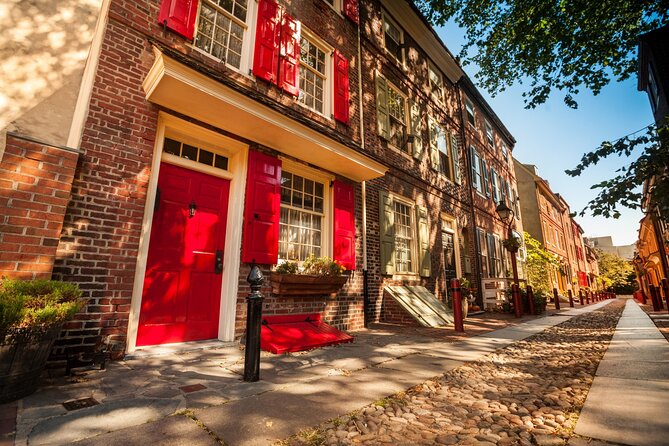
Next up is Elfreth’s Alley, famous as a historic street dating back to 1703. It’s a National Historic Landmark, with 32 houses that were built between 1703 and 1836. The Elfreth’s Alley Museum sits at #124 and #126, so you’re in a block that’s packed with story even before you start solving.
This is one of those places where the puzzle approach really helps. A walking tour might tell you the street is old and charming. The game makes you look: you’re searching for the clue answer that lets you progress.
Practical tip: Elfreth’s Alley is narrow, so you’ll want to keep your phone use quick and then look up again. You’ll get more out of it that way, and you won’t clog the path for others.
A chain of checkpoints (the “solve, then go” rhythm)
Between major named stops, the route follows the same formula: you arrive, you’re given an on-screen prompt, you look around to find the answer, and then you move onward. There’s a segment in the provided notes where a stop label is blank, but the key idea remains clear: the app handles the next move and the route continues in sequence.
This structure is why the experience can work well for many kinds of travelers:
- History lovers get meaning because the landmarks are real and specific
- Puzzle lovers get momentum because each correct answer advances you
- Families get breaks without the tour stopping for everyone
You do need to pay attention to the app’s on-screen direction changes. If you wander off because you’re distracted by a nearby storefront or cafe, it’s easy to lose time. The fix is simple: pause, read the next instruction, then move.
Philly at a walking pace, more routes






The Second Bank of the United States: banking meets clues
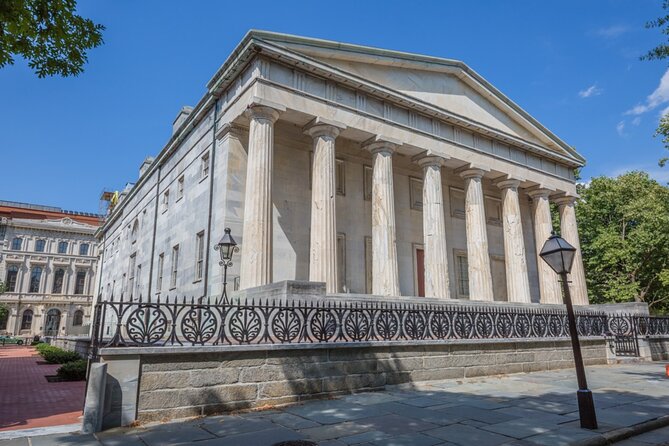
A standout stop on your route is The Second Bank of the United States. It was the second federally authorized Hamiltonian national bank in the U.S., operating on a 20-year charter from February 1816 to January 1836.
This is a clever inclusion because it balances the independence story with the real-world systems that followed. Independence is big and dramatic, but a country also needs money to function. So when you hit this bank stop, you’re seeing how the early U.S. built institutions, not just ideals.
At this checkpoint, the game again asks you to look for the answer to move forward. Since banks can feel intimidating or purely architectural to some visitors, a puzzle can be a good way to keep the experience active instead of passive.
Independence Hall: the centerpiece of the whole case

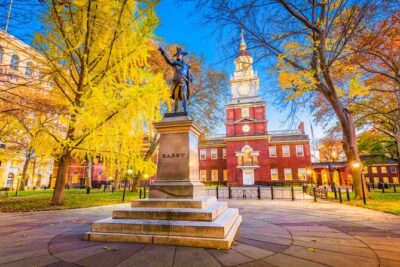
You’ll then reach Independence Hall, the place where both the Declaration of Independence and the U.S. Constitution were debated and adopted. It sits at the core of Independence National Historical Park, and it’s also a UNESCO World Heritage Site.
This stop is the heart of the route, and the puzzle format helps here too. If you come expecting a dramatic museum-like experience only, you might still enjoy it. But with the app in charge, you’ll probably slow down for specific details and make connections as you walk.
The main drawback at landmark-heavy sites is simple crowd energy. The route is always available, but popular places can still be busy. Your best strategy: keep your phone steps short, follow the game prompt, then step aside if you need space to read or solve.
Christ Church and Franklin’s burial ground: turn monuments into questions
After Independence Hall, the route brings you to Christ Church, founded in 1695 as the first parish of the Church of England in Pennsylvania. The current building was constructed between 1727 and 1744, which shaped it into a grand example of Georgian architecture.
Right nearby, the route also points you to the burial ground where Benjamin Franklin and his wife Deborah are buried, plus the man who dug their grave. The burial ground was acquired by Christ Church in 1719, when its churchyard cemetery was full.
If you love Franklin as a name more than a person, this combination can help you reframe him. The clue-based walk nudges you to notice how one religious site holds both architecture and life stories—then it connects you to the next stop.
One practical note: at burial-related spots, people tend to slow down out of respect. Build in extra patience for your puzzle-solving pace. The game is designed for walking, but the environment can naturally ask you to be a little calmer.
The National Constitution Center: where the case keeps going

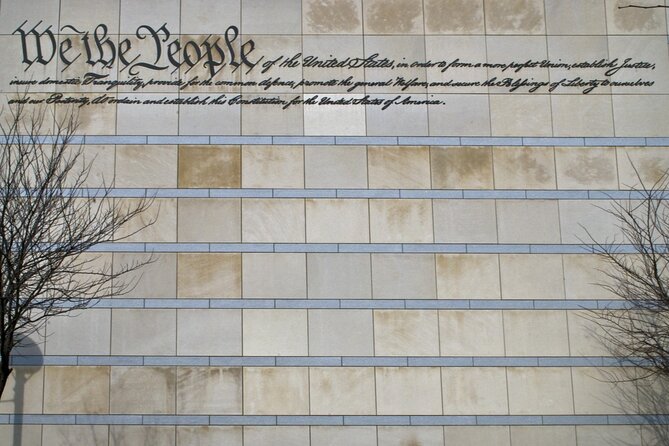
Next you’ll reach the National Constitution Center, a nonprofit institution devoted to the Constitution of the United States. Even if you’ve visited Philly before, this kind of stop fits the “case” theme well because the whole walk is about how civic life formed.
You’ll again have to look around to find the answer that advances you. If you like architecture and symbolism, this is likely to feel rewarding. If you’re more of a “tell me what I’m seeing” person, you’ll still benefit, but you might spend longer on each puzzle because you’ll be doing interpretation on your own.
Liberty Bell: the symbol everybody recognizes
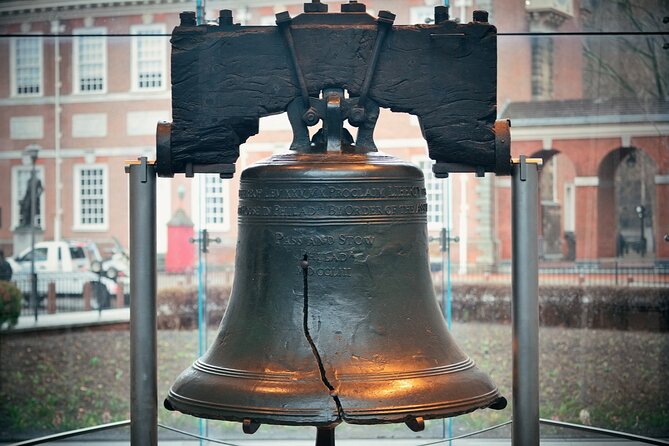
Then comes the most famous icon on the route: the Liberty Bell. It was previously called the State House Bell or Old State House Bell, and today it’s an iconic symbol of American independence.
Because this landmark is so widely known, you might think you’d “already get it.” The puzzle approach changes that by asking you to hunt for a specific clue tied to what you’re seeing, which keeps you from glancing and moving on too fast.
Expect this to be a “read, look up, solve, repeat” stop. Give yourself time. If you try to rush, you’ll end up re-reading the prompt more than once.
Chinatown born in 1870, then Reading Terminal Market takes over
From there, your route heads into Philadelphia’s Chinatown, described as being born in 1870 with a laundry at 913 Race Street owned by Lee Fong. The story also notes how many Chinese migrants moved east to form small “bachelor societies” amid anti-Chinese sentiment in the West.
That neighborhood history matters here because it turns Chinatown from a food stop into a place with origin and context. You’re walking with a question in your head, so you’re more likely to notice signs of community life and the way the neighborhood evolved.
After Chinatown, you finish your day with Reading Terminal Market at 1136 Arch St—your endpoint. The market opened in 1893, covering about 78,000 square feet with nearly 800 spaces for merchants in six-foot stalls. It was laid out on a grid system similar to Philadelphia streets, with twelve aisles and four avenues.
This final stretch is a smart choice. Markets are good “landing zones” after puzzles because you can reward yourself on your own schedule. If you’re tired, you can just sit and snack. If you’re energized, you can browse and make it part of the celebration.
African American Museum: a meaningful close to the route
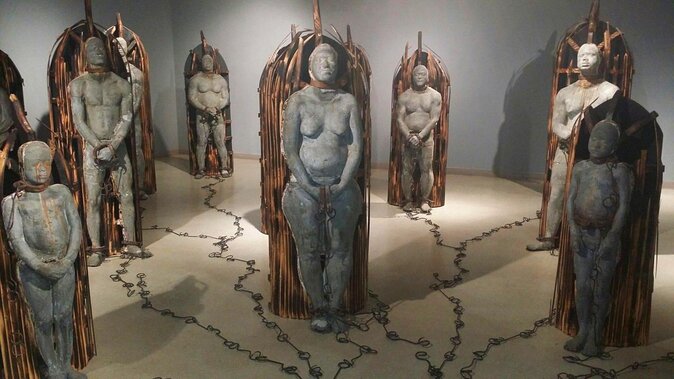
Near the end of your walk comes the African American Museum in Philadelphia, founded in 1976. It’s described as the first institution built by a major U.S. city to preserve, interpret, and exhibit African-Americans’ heritage and culture.
This stop gives the route a fuller view of America beyond independence documents and founding-era institutions. It’s also a reminder that “history” is not one story. The app’s look-around puzzle keeps it active rather than turning it into a quick photo stop.
By the time you’re here, you’ve already solved your way through a sequence of civic, economic, and neighborhood markers. That’s why this museum inclusion can land well: it’s not tacked on. It connects to the broader theme of how communities shape the U.S.
Price, time, and real value: $7.19 worth it?
At about $7.19 per person for roughly 1 hour 30 minutes, the math is pretty friendly—especially since it’s 24/7 and start whenever you want. You’re paying for guidance, pacing, and a structured way to explore, not for a human tour guide.
The real value is the combo of:
- Offline play, so you’re not paying for data or stressing over coverage
- Flexible timing, so you don’t lose the day to waiting
- Checkpoint-to-checkpoint momentum, which helps you see more than you’d on a casual stroll
If you have kids, the perk is bigger: it’s free for kids. That can make this one of the more budget-friendly ways to get a “do something together” day in Philadelphia.
Who should book this puzzle walk?
I think it’s best for you if:
- You enjoy puzzles, scavenger-style walking, or “find the answer” games
- You want to cover a lot of landmarks in a single plan without a tour schedule
- You like history, but you want it delivered by actions, not lectures
- You’re traveling with a group that moves at different speeds
It’s less ideal if:
- You hate using your phone outdoors
- You’re likely to forget charging or you don’t want battery anxiety
- You prefer a live guide to explain everything on the spot
A small but important access tip (don’t get stuck at check-in)
One practical snag can happen when access isn’t properly connected to the app. Make sure your ticket works in the Questo app before you start walking. If an unlock link fails, you may need to handle it inside the app rather than relying on a separate link from wherever you bought.
If you hit that wall, contact the support team tied to the experience provider. It’s usually faster than trying to brute-force the route while standing around.
Quick FAQ
FAQ
How much does this experience cost?
It costs $7.19 per person.
How long does the puzzle walk take?
Plan on about 1 hour 30 minutes (approx.).
Do I need an internet connection?
No. It supports offline play, so you don’t need internet connection while exploring.
Where does it start and where do I finish?
It starts at Spruce Street Harbor Park (301 S Christopher Columbus Blvd) and ends at Reading Terminal Market (1136 Arch St).
Can I start at any time during the day?
Yes. It’s permanently available, and you can start at any hour. It’s listed as running 12:00 AM to 11:30 PM daily.
What language is it offered in?
It’s offered in English.
Is it a guided tour with a person?
No. It’s a self-guided experience delivered through the Questo app with step-by-step directions.
Is this experience private for just my group?
Yes. It’s described as a private tour/activity, so only your group participates.
Is there a kid discount or kids go free?
Yes. It’s listed as free for kids.
Can I cancel and get a refund?
Yes. You can cancel for a full refund up to 24 hours in advance. If you cancel within 24 hours of the start time, the amount paid is not refunded.
Should you book this puzzle walk?
Yes, if you want a low-cost, flexible way to see Philadelphia’s big landmark hits without committing to a set guided schedule. The best reason to book is the offline, step-by-step design—so you can keep walking and solving instead of hunting for your next turn.
If you’re the type who enjoys strolling while actively noticing details, this fits your style. If you’d rather have a person explain everything and you don’t want to rely on an app, you might be happier with a traditional guided tour.
More Philadelphia Walks, Step by Step
More Tour Reviews in Philadelphia




Crack the City: More Philly Trails



Fresh Off the Press: Latest Philadelphia Reviews










Escape Games & Scavenger Hunts, compared.
 ★ 5.0The Escape Game: 60-Minute Adventures at King of Prussia MallFrom $4279 reviews
 ★ 4.5Outdoor Escape Room in Philadelphia – Logan SquareFrom $7518 reviews
 ★ 5.0Vintage Thrift Quest Walking Tour in Philadelphia6 reviews
 ★ 4.0Philadelphia Founding Father Quest and Self-Guided TourFrom $75 reviews
 ★ 4.5Philadelphia Murder Mystery: Ben Franklin Detective GameFrom $53 reviews
 ★ 3.5Philadelphia Scavenger Hunt & Highlights Self Guided Audio TourFrom $83 reviews
 ★ 3.5Self-Guided Philadelphia Scavenger Hunt: People Who Made AmericaFrom $133 reviews
Browse the lists this tour appears in